Uncategorized
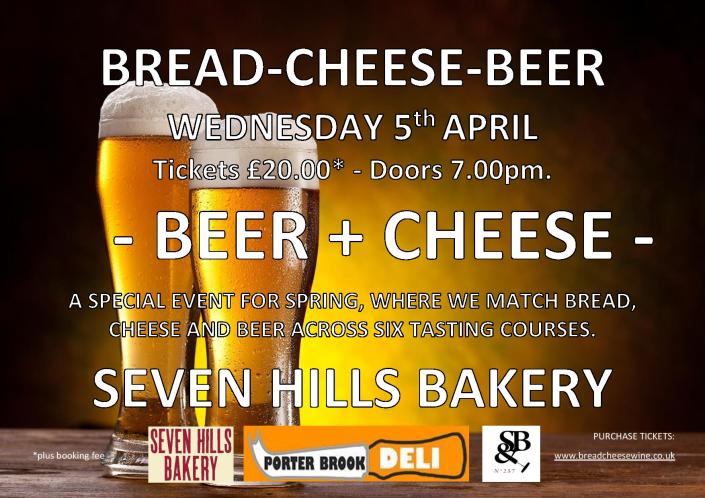
APRIL 2016 – BREAD CHEESE BEER
BREAD
CHEESE
Richard III Wensleydale
An ancient Wensleydale recipe that produces a moister, less-crumbly, acidic cheese. At The Courtyard Dairy it is sold in the traditional manner at one month old, Richard III Wensledyale flavour is clean and light with a gentle, milky and lemony flavour. Made by Andy Ridley in Richmond, North Yorkshire, England.
Baron Bigod
Baron Bigod is Britain’s first unpasteurised Brie to be made on the farm in traditional large (3 kg) form and ladled only by hand.
Made by Jonathan and Dulcie Crickmore at Fen Farm Dairy in Suffolk. Falling milk prices prompted them to diversify into cheese making. Seeing a gap in the market for a large (3 kg) unpasteurised Brie (similar to Brie de Meaux) they started to develop Baron Bigod. This involved purchasing a herd of French cows (Montbeliarde) to provide the rich milk needed to complement their newly acquired cheese-making skills.
Hafod Cheddar
Hafod Cheddar is hand made in small quantities using just the milk from the small herd of Ayrshire cows that graze on the organic pastures of Holden Farm in West Wales. The recipe is inspired by techniques used 100 years ago with an emphasis on slow, gentle and cool treatment of the sweet and rich milk and curd.
Hafod is traditionally bound in cloth and lard and matured for about a year. The flavour is described as “deep and mellow, rich with butter and with just a hint of sharpness”.
Hartington Stilton
Made in the Peak District this is the only Derbyshire Stilton, gaining its status in 2015 following a reopening of the creamery. It is a classic Stilton.
Wyngaard Goat Gouda
Mature Goat Gouda cheese that is smooth and melts in the mouth. It is tangy, not too salty, full of flavour and fresh tasting. Made in the Netherlands by Wijngaard Kaas.
Taleggio
Pinkish in colour. Its rind is soft and thin. The paste is uniform and compact. The taste is slightly sweet with a hint of tartness. A pasteurised cow’s milk cheese from Novara. Made by Mario Costa.
BEER
LINDEMANS LAMBIC APPLE – 3.5% – BELGIUM
Southwest of Brussels, in the quiet Belgian town of Vlezenbeek, the Lindemans family has been farming and home-brewing as long as anyone can remember. Commercial brewing started in 1822.
Lambic, or spontaneously fermented beers, are the beers of this region and are among the world’s rarest: they are the only beers fermented via wild, airborne yeast – no yeast is added by the brewers. Lambics come only from the Senne River valley, near Brussels – a region about 15 by 75 miles in size.
In the mashing process 30% unmalted wheat is added to the malted barley and aged hops (as opposed to fresh hops) are used for the preservative process and not for the addition of bitter hop flavours. After the boil, lambic wort is transferred into a coolship (a large, shallow vessel) that exposes the hot wort to the cool fresh air and wild yeast! Outside air – laden with floating wild yeast cells, in a natural balance – can enter the coolship rooms via louvers in the walls.
The beer is top-fermented by multiple wild yeast strains, including Brettanomyces bruxellensis and Brettanomyces lambicus; most ales use the cultivated yeast Saccharomyces cerevisiae.
After fermentation, the beer is transferred into fermenting vessels for two summers of maturation. A second, slower fermentation takes place here, influenced by oak, either in an oak cask or in steel with oak chips added. After aging, the base lambic is treated in different ways to make different beers. For fruit lambics, fresh fruit juice is added just before bottling.
Clean, bright aroma and flavour of apples melds beautifully with the complex tartness of lambic. Smooth, light body with the fresh flavor of real apples and a light green-apple tartness.
Wensleydale and apple are a classic match so we’ve paired this with a lovely, light, lower alcohol lambic beer.
HOPF HELLE WEISSE – 5.5% – GERMANY
HefeWeisse is a south German style of wheat beer (weissbier) made with a typical ratio of 50:50, or even higher, wheat. A yeast that produces a unique phenolic flavors of banana and cloves with an often dry and tart edge, some spiciness, bubblegum or notes of apples. Little hop bitterness, and a moderate level of alcohol. The “Hefe” prefix means “with yeast”, hence the beers unfiltered and cloudy appearance.
Hopf Helle Weisse is a Hefeweizen style beer brewed by Weissbierbrauerei Hopf in Miesbach, Germany. Founded in 1892 they now brew 11 different wheat beer varieties. It is also the sister brewery to Hacker-Pschorr. Helle Weisse is top fermented, unfiltered and uses a 2/3 wheat malt and 1/3 barley malt mash. Typical white beer flavours with banana and clove.
The crumbly texture of the goats cheese is a great match to the softer flavours of the wheat beer.
BAYERISCHER GOSE – 4.6% – GERMANY
Gose is predominately a wheat, low ABV beer that has a slightly sour lemon tart taste. Thirst quenching and refreshing. . It is a top-fermented beer brewed with the addition of lactic acid, coriander and salt and no hop flavors.
Many German beers take their take from the towns where they are brewed so its possible that Gose also takes its name from the town of Goslar where it was first brewed (or more likely the river Gose which runs through the town). Although the earliest recorded document dates to 1470AD for brewing Goslar beer its possible that it dates back to around 1000AD. Leipzig Gose is a more sour version of its Goslar cousin and takes credit for the survival of this beer style that almost became extinct in the 20th Century until it was revived by the micro-brewers in the UK and USA. Modern examples are from Chorlton Brewery and Magic Rock’s Salty Kiss.
The idea behind this match is that the saltiness of the Stilton will complement the saltiness of the Gose and should then bring out some of the more subtle citric fruit of the beer. Another good match would be to put on a dark roasted porter.
THORNBRIDGE JAIPUR – 5.9% – UK
Thornbridge beers were first brewed in early 2005 after a 10 barrel brewery was established in the grounds of Thornbridge Hall, Derbyshire. From the beginning, Thornbridge’s vision was to create beers that would make them one of the UK’s leading new breweries and the adoption of the ‘Innovation, Passion and Knowledge’ strap line being a statement of the brewery’s culture.
The immediate impression of this wonderful multi award-winning (over 100) India Pale Ale is soft and smooth but this builds around the mouth to a crescendo of massive hoppiness accentuated by honey. Jaipur uses six different hops to build up its complex American style IPA flavour.
The idea behind this match is to find a beer strong enough in flavour to take on the Havod. The big upfront hop flavours should be a great match and bring out different flavours in each.
ORVAL – 6.2% – BELGIUM
The Brasserie d’Orval is a Belgian trappist brewery located within the walls of the Abbaye Notre-Dame d’Orval in the Gaume region of Belgium.
They produce just two beers, Orval and Petite Orval (the latter only available from the the monastery itself – known as a Patersbier). Distinctive in it’s skittle-shaped bottle, Orval was first created in 1931 and has grown to iconic status and described by the beer critic Michael Jackson to be “a world classic”.
Authentic Trappist Beers can only be brewed by registered Trappist breweries (formed in 1997): there are 11 monasteries that brew (6 in Belgium, 2 in the Netherlands, 1 in Austria, 1 in Italy and 1 in the USA). They must be brewed by monks or under supervision, it must not be the main purpose of the monastery and observe monastic practises and it must not be for profit, with the income used to maintain the monastery and living expenses of the monks with the rest donated to charity.
Orval is a very dry, herby beer which is ideal as an aperitif and characterised by a bouquet of fresh hops, with a fruity note and pronounced bitterness. As with other Trappist beers, the flavours will change depending upon the age of the beer and the temperature it is served at.
Particularly pungent wash rind cheeses cope really well with bigger style beers and Orval, with its dry hopped character and use of the local wild Brettanomyces yeast (responsible for adding a “funkiness” to the beer) suit cheese like this really well.
SCHLENKERLA MARZEN – 5.1% – GERMANY
Smokebeer from Schlenkerla is a dark, aromatic beer which achieves its smoky flavour by exposing the malt to intense, aromatic smoke from burning beech-wood logs at the Schlenkerla-maltings. First mentioned in 1405, the Historical Brewery Tavern Schlenkerla can be found in the middle of Bamberg, directly beneath the mighty cathedral.
The classic, magnificent-tasting beer has a distinct aroma through its palate to a clean, dry finish – a wonderful flavour which may come as a bit of a shock at first! A bit of a left-field pairing, the idea of this is to recreate a bacon and brie sandwich! The Bigod is quite a pungent Brie and hopefully can stand up to the smokiness, with the creaminess of the cheese providing a counterfoil to the flavour of beer. A side of fruit should hopefully add a touch of sweetness to the combination and bring it back into balance.
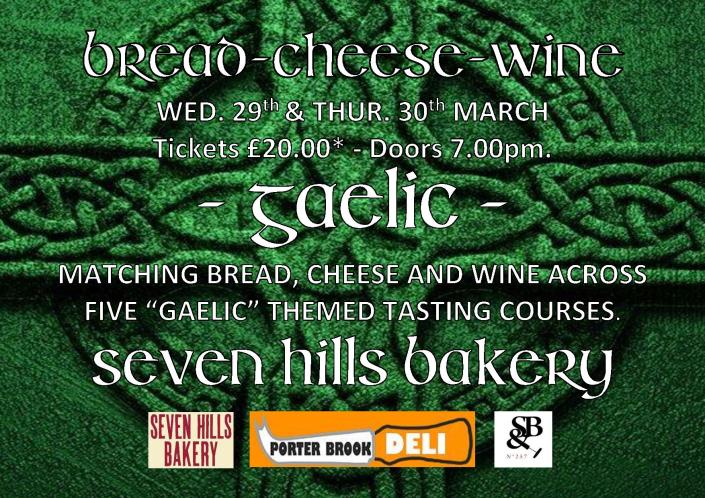
MARCH 2016 – GAELIC THEME
Image Posted on Updated on
1. IRISH SODA BREAD – Killeen Goats – Tomatoes – Cabernet Franc This bread is out version of the Irish classic, but using 100% Yorkshire wheat. Yorkshire Organic Millers grind a course wholemeal especially for us for use in this bread. The bread is naturally sweet because of the wholewheat and is very soft as a result of the Organic Buttermilk which is made for us, also specially, by Acorn Dairy in North Yorkshire. There is no yeast in this bread as it is leavened by the alkaline bicarbonate of soda reacting to the acid in the buttermilk. This creates the scone like texture.
2. OATCAKES – Teifi – Plum & Date Chutney – Macon Charnay We have used pinhead oatmeal and rolled oats to make these oatcakes. They also have some dates for a little natural sweetness. Their crumbly texture really compliments the semi hard Teifi.
3. OVERNIGHT BLOOMER – Isle of Mull Cheddar – Apple – Bordeaux We’ve tried to recreate a worker’s lunch with this course so have chosen to show the CHEESE off with our bloomer. It is ‘overnight’ because the dough is mixed in the morning and left to bulk ferment overnight before being shaped, proved and baked the following day. This long fermentation allows to put a very, very small amount of yeast in the bread and also gives it a lovely chewy texture.
4. LEEK & POTATO SOURDOUGH – Young Buck – Braised Leeks – Beaujolais Villages Our sourdoughs are made with just three ingredients: flour, water and salt. Making bread this way is very traditional. We ferment flour and water together and this leavens the bread instead of using fresh or dried yeast. The bread is made over three days as this method generally needs much longer to prove than yeasted breads. The long fermentation gives it a chewy, holey structure and slightly sour taste. We have added roast potatoes, leeks and rosemary to this white sourdough for a Welsh touch! The added starch from the potato is what gives the bread the ‘custardy’ texture.
5. LAVENDER SHORTBREAD – Caerphilly – Rhone Valley Viognier We have added dried lavender to a traditional all butter shortbread biscuit – what could be more Scottish! We hope that the floral notes will complement the zesty, lemony flavour of the cheese helping to cut through the richness.


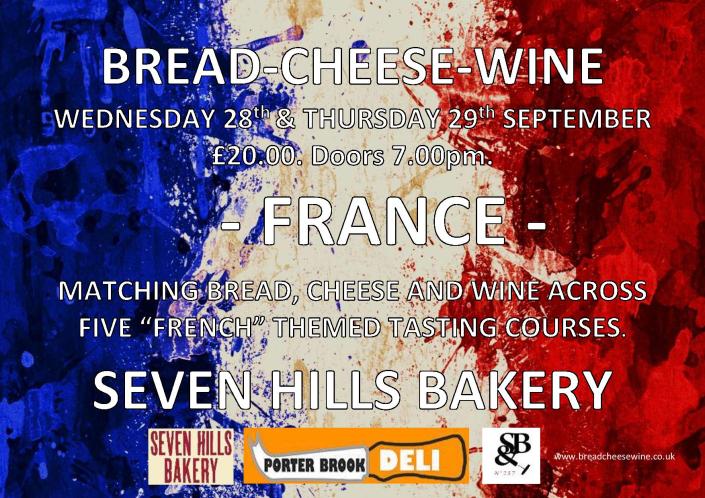
SEPTEMBER 2016 – FRANCE THEME
BREAD
1. CHESTNUT PAIN DE CAMPAIGNE This bread is a sourdough, meaning that no yeast has been added to the dough. The name means ‘country bread’ and was traditionally baked in communal ovens in a round or miche.It is fermented and risen over three days giving it the charistically strong flavour and chewy texture. We have added cooked chestnuts to the dough which gives it a nutty flavour and soft, creamy texture.
2. GOATS CHEESE, RED ONION & THYME FOUGASSE This is a classic French bread that is either made plain (as we do daily) or flavoured as tonight’s is. It is made from our Overnight White dough and is shaped and cut with a scraper before being proved, baked and coated in olive oil. An amazing snack!
3. BAGUETTE The most iconic of all French breads! Despite this the name ‘baguette’ didn’t become common until the 1920’s. It is derived from the Italian bacchetta meaning ‘wand’. This is made over 2 days with a poolish (one third of the total flour and water and a small amount of yeast) fermenting for 14-15 hours in the fridge. In the morning this is then added to the remaining dough ingredients, proved, shaped and baked. This is the bread that takes us the longest to make, being the first thing mixed and the last out of the oven. If it weren’t for this dough we could get out of bed later!!
4. POILANESTYLE SOURDOUGH Lionel Poilâne is a French artisan baker famed for his 2kg miche loaves that are now exported all over the world. He was a champion of traditionally made, sourdough breads and the bakery, now run by his daughter, still trains bakers in the traditional methods of production. The Poilâne miche is made from 85% extraction flour, also called ‘grey flour’ which we buy from Yorkshire Organic Millers and spelt flour. This is our version.
5. UK APPLE TART TATIN We are celebrating the first of the UK apples by making another French Classic. The tart is thought to have originated in the Hotel Tatin south of Paris. We have made puff pastry but layering Lescure butter (a French butter with a high butterfat content) with pastry dough. Apples are sliced and layered into a mold with butter and sugar then the pastry is laid on top. This is all baked and then inverted. Perfect with the apple based Calvados and Cidre.
CHEESE
From the Jura mountain region comes one of France’s favourite cheeses – this one is made by Marcel Petite. Smooth, mellow, nutty and with a long finish.
Epoisses
Burgundy’s most pungent cheese and its most famous. It is powerful, luscious and a real cheese connoisseurs’ choice. Full flavoured, with a soft, oozy texture.
Morbier
A semi-soft cows’ milk cheese of France named after the small village of Morbier in Franche-Comté. It is ivory coloured, soft and slightly elastic with a thin black layer separating it horizontally in the middle. It has a rind that is yellowish, moist, and leathery.
Traditionally, the cheese consists of a layer of morning milk and a layer of evening milk. When making Comté, cheesemakers would end the day with leftover curd that was not enough for an entire cheese so they would press the remaining evening curd into a mould, and spread ash over it to protect it overnight. The following morning, the cheese would be topped up with morning milk. Nowadays, the cheese is usually made from a single milking with the traditional ash line replaced by vegetable dye. The aroma of Morbier can be strong and the flavour is rich and creamy, with a slightly bitter aftertaste.
Chevre Goats’ Cheese log
This is the classic, white mould rind goat log.
Fourme d’Ambert
A succulent and classic blue from the Auvergne. The cheese is aged for ten weeks by affineur Xavier Morin, to create the richest creamiest texture. Fourme d’Ambert has a delicate blue flavour, and is soft and smooth.
WINE
NOIX DE LA SAINT JEAN
From the Forcalquier distillery in Provence and a delicious way to start the evening with this stunning walnut aperitif. Dauphine Green Walnuts are harvested whilst still unripe and before the shells begin to harden, this must happen before or on the 24th June, which is known as St. Jeans Day (or better known to us as John the Baptist) and which gives this drink its name. To enhance the flavour of the walnuts the distillery combines them with nutmeg, cinnamon and cloves to give the aperitif its spicy, fruity flavours. This should complement the chestnut bread and the Comte perfectly, enhancing the nut flavours of this serve.
St.Veran Cuvee Tradition Doamine Thomas
This family run estate has developed during the past three generations with Lucien now in charge with the support of his father. The Chardonnay is the all important component here as it is throughout the Maconnaise. The fruit displays a crispness on the opening followed by good depth of flavours. As the lemony tones fade the peachy notes are apparent. With the fullness of the cheese the wine develops and keeps the palate interested.
Chereau Carre Muscadet ‘Sur Lie ‘
With the vineyards situated near Nantes on the Brittany coast, the Atlantic ocean does play a part in the character of the wine. Cooling breezes in the summer are helpful so not to stress the ripening grapes. The ripened Melon de Bourgogne grapes are harvested in parcels from mid September. Sur lie refers to the wine being left on the dead yeast cells to add character and depth. Muscadet is not just for seafood and salad.Using it here with the Goats cheese log I am looking to balance the acidity of the cheese and the ripe grapey wine.The red onion and thyme is refreshed by the dryness of the Muscadet.
Maison Nicolas Perrin Syrah
The northern Rhone provides some fantastic Syrah .This is a collaboration between two well respected families. The Nicolas is Jaboulet and the Perrin is Mark. The grapes provide crunchy dark berry fruits with a hint of black pepper spice.The wines is made in steel vats and a part is moved to large oak barrels for a short 4/5 month rest before rejoining the rest for bottling. A juicy and fruity Rhone red works well with the creamy delicate nature of the blue cheese.
DROUIN CALVADOS AND CIDRE
Christian Drouin was an Industrialist when he bought a farm in Gonneville in the 1960s. His aim was simple: to produce a top quality spirit using the farms orchard apples. He passed this passion down to his son (also Christian) and now the company is in the third generation of Drouin. In 1995 the whole estate was recognised by the European Prestige Grand Prix Award, representing the quintessence of calvados.
AUGUST 2016 – SEASIDE THEME

BREAD CHEESE WINE AUGUST 2016 SEASIDE THEME
1 TXAKOLI PINTXOS W/ MANCHEGO BATON Our baton, or baguette one of our best selling loaves. It takes the longest to make of all our yeasted breads. It is made using a poolish. This is where 30% of the total water and flour is added to a very small amount of yeast, mixed and left to ferment overnight in the fridge. The final dough is then mixed in the morning, left to ferment again, then shaped, proved and baked. This long fermentation gives the bread a chewy and open texture. This is the perfect vessel for the tapasstyle toppings.
2 Picnic Lunch! CUDDYS CAVE OVERNIGHT WHITE BLOOMER SANGRIA So called the ‘overnight white bloomer’ because this is the only dough that we leave to ferment ambiently overnight. It is the last thing that the bakers do on their shift and i first bread that they mould in the morning. This is a yeasted bread but even in the depths of winter-it only has 1% yeast per 1g flour, this goes down to 0.25g in the summer. It often has adeceptively dark crust, this is because the sugars in the wheat have been released through the long fermentation process making it colour quicker. This loaf will always have a soft crust though, unlike sourdough which usually has a crispy one. The softness and closer texture makes this a perfect sandwich loaf.
3 LAVERBREAD SAUMUR CAERPHILLY Laverbread isn’t really a bread! It can be make thickly or made into boules like stuffing but i decided to make it more like a biscuit or cracker. Laver is seaweed, you may know its more common name of Nori. The seaweed is cooked and butter and oatmeal are added to create a dough that is then baked to a crisp.This is a very traditional Welsh food, so goes especially well with the Caerphilly.
4 OGLESHIELD CHEESY CHIP BUTTY ON BUTTERMILK ROLL VINO VERDE You’ve got to have chips when you’re at the seaside -right?! We used our buttermilk rolls to go with this course. We use local buttermilk from Our Cow Molly to make these soft rolls. We bought chips from Two Steps across the road and melted Ogleshield on top. The Vino Verde provides a delicious acidity to cut through the grease.
5 CORNISH BLUE CHEESE ICE CREAM TUILLE PEDRO XIMINEZ
Maybe not the icecream that you would expect at the beach, but this subtle blue cheese matches beautifully with the rich rasiny flavours of the sherry. A treat to finish…
-CHEESE-
Manchego
Manchego is a raw ewes’ milk. Hard and crumbly with a few tiny crystals of tyrosine. Aromas of leather, wool and nuts. Complex, fruity and buttery flavour with an aftertaste of nuts and a gentle spiciness. From Alcazar de San Juan, Castile La Mancha and aged for a minimum of seven months.
Cuddy’s Cave
Cuddy’s Cave is a mellow and succulent Dales style cheese, developed from Neill Maxwell’s own recipe at Doddington Dairy in Northumberland. Its flavours are fresh, lemony and curdy when young yet rich, mellow and satisfyingly creamy once matured. Unpasteurised, traditional rennet. Matured from three to six months.
Ogleshield
With his Jersey herd of cows, Jamie Montgomery makes a raclette-style cheese. Ogleshield is washed for three-months and is perfect for raclette grilling or simply eaten on its own! Made by Jamie Montgomery in North Cadbury, Somerset, England. Unpasteurised. Animal rennet.
Gorwydd Caerphilly
At five-months old, this traditional Welsh Caerphilly has been extra-matured to break it down to form a buttery, mushroomy layer around a lemony, lactic-fresh core. Made by Todd and Maugan Trethowan in Puxton, Somerset, England. Unpasteurised. Animal rennet.
Cornish Blue
Cornwall’s only blue cheese. A gentle blue with a creamy, mellow flavour. From Liskeard on Bodmin Moor, Cornish Blue Cheese Cheese has been produced on the Stansfield’s Farm since 2001. The full flavoured sweet, creamy cheese of distinctive character has been internationally recognised by the many awards it has won including: World Cheese Awards Champion Cheese in 2010 and Best Blue and English Cheese in 2007. Pasteurised. Animal rennet.
-WINE-
Agerre Txakoli (known as Chacoli )
One of Spain’s more unusual wines, which like Vinho Verde loves being close to the sea. The location is a mere 750 meters from the shore. In the autumn and winter months the rainfall is high ,as much as 1500mm per year. The main grape used for this wine is Hondarribi Zuri which can produce thin and acidic wines. This example is fuller flavoured with a light spritz.
Sureo Sangria from Estrella Damm
Named after the Spanish and Portuguese word for “blood” (sangre) because of its typical dark colour. Sangria is commonly a mixture of red wine, chopped fruit – such as orange, lemon, melon, berries, mango, a sweetener is added – sugar, syrup or orange juice as well as a small amount of brandy or sometimes rum. As there are so many variations on a recipe the drink can range in alcohol from 4% to 11%. Sangria is now protected under a 1991 European law and can only be labelled as such if produced in Spain or Portugal. The law states that it must be less than 12% abv and the colour must come exclusively from the raw materials used. Solid citrus fruit pulp or peel may also be included. Sureo comes from Barcelona based Estrella Damm and it is possible that the recipe for it has come from El Bulli chef Ferran Adria.
Saumur Rouge ‘ Les Plantagents ‘
A well balanced offering with plenty of red berry flavours provided by the Cabernet Franc grape. The vineyards are close to the Chateau at Saumur and the banks of the River Loire. The grapes are lightly pressed at the winery after careful selection and de-stalking. This Saumur has lighter tannins and is best drunk within a few years of making.The red berry fruits and the dry finish work well with the cheese keeping the palate clean.
Este Vinho Verde made from the Loureiro variety in Galicia
A large family estate produces a host of white and red Vinho Verde. Situated close to the Atlantic shores this can be a tricky area to grow vines.nSince the 1990’s the style has changed a little, to provide more fruit flavours without losing the freshness and zing on the palate. The demand for lighter wines in character and alcohol is increasing and the quality is only getting better.
El Candado Pedro Ximinez from Bodegas Valdespino
Inspired by a family member who thought it would be highly amusing to put a lock on one of their prized barrels. Thankfully we can all enjoy this delight today with the care of excellent fruit and wine making. This Pedro Ximinez variety is thin skinned and light green.After ripening and then picking it enjoys at least two weeks in the sun to lose some juice and sweeten what is there from the season. Gentle ageing for around ten years brings this smooth figgy and dried fruit cocktail of flavours to life.
Save
JULY 2016 – YORKSHIRE THEME
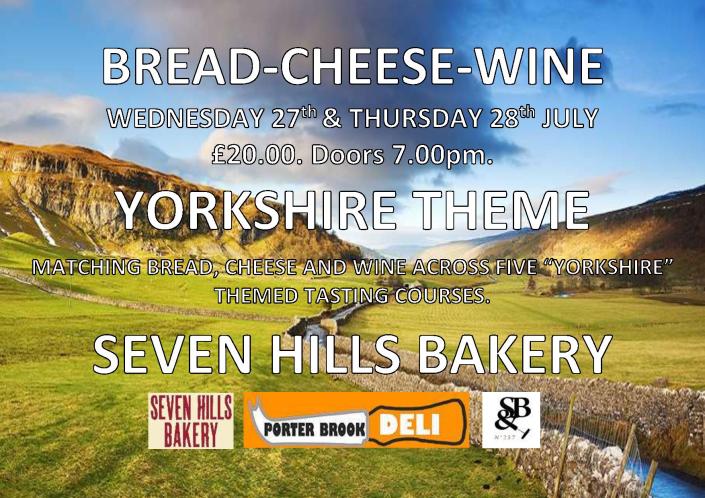
BREAD
BCW JULY 2016 YORKSHIRE
1. WALNUT & SULTANA RYE Dale End Cheddar Locksley Gin This is made with 100% Yorkshire Grains. The rye is milled in Barnsley at Worsborough water mill and the wheat is grown and milled by Yorkshire Organic Millers. This bread is a sourdough, meaning that no yeast has been added to the dough. It is fermented and risen over three days giving it the charistically strong flavour of rye bread. We have added toasted walnut, sultana and some black treacle to bring out the sweetness in the grains. This should be a great contrast to the freshness of the gin.
2. SHARROW SOURDOUGH Ribblesdale Goats Pinot Noir Our sourdoughs are made with just three ingredients: flour, water and salt. Making bread this way is very traditional. We ferment flour and water together and this leavens the bread instead of using fresh or dried yeast. The bread is made over three days as this method generally needs much longer to prove than yeasted breads. The long fermentation gives it a chewy, holey structure and slightly sour taste. Sourdough breads also have natural keeping qualities because they are slightly acidic (which prohibits mould growth). We think that the slight tang complements the strength of the cheese.
3. SPELT BREAD Sommerfield Pericone This wheat is milled by Worsborough Mill on Barnsley. And yes, it is a wheat! Lots of people think that it isn’t! Spelt is an ‘ancient’ grain, meaning that it hasn’t been cultivated or developed for high manufacture and as such some people find it easier to digest. It has a delicious naturally nutty flavour that should go amazingly with the Alpinestyle Sommerfield.
4. SODA BREAD Blue cheese selection Baccus/Savauvignon This bread is out version of the Irish classic, but using 100% Yorkshire wheat. Yorkshire Organic Millers grind a course wholemeal especially for us for use in this bread. The bread is naturally sweet because of the wholewheat and is very soft as a result of the Organic Buttermilk which is made for us, also specially, by Acorn Dairy in North Yorkshire.
5. STOUT CAKE Cream Cheese topping Bete Noir Debortoli Semillion We have opted for a plain scone so that the curd and berries can shine. We use organic, uncultured buttermilk that is bottled for us by Acorn Dairies in North Yorkshire. Scones rise because of a chemical reaction between the acidity of the buttermilk and the bicarbonate of soda mixed in with the flour. This reaction happens as soon as they touch so need to go straight into the oven to ensure a light, fluffy texture.
CHEESE
Dale End Cheddar
Dale End Cheddar is made in Botton from full-flavoured, quality unpasteurised milk collected from the Camphill Community’s 46 Dairy Shorthorn cows (a traditional Craven breed known for the superb quality of their milk).
The Courtyard Dairy decided to stock the Cheddar and age it to 18-months old, by which time it is rich, with a sharp Cheddar bite.
Summer Field
Alastair Pearson also makes Summerfield, an Alpine-style cheese. Gruyère-style cheeses are notoriously difficult to make and cannot be made from silage-fed animals (for technical reasons), so whereas Botton’s Dale End Cheddar can be, and is, made all year round, Summer Field is only made when the cows are out at pasture and thus in very limited supply. This pasture-grazing gives the cheese its name – Summer Field.
Ribblesdale Goat Curd
Curd is a very fresh and young form of cheese. Curds are created when the rennet and starter culture are added to the milk and these separate out the liquid whey which is drained off. A small amount of salt is added to finish it off.
Blue Monday
Blue Monday is a complex cheese with a spicy bite from the blue – a mix of blue sharpness + sweet creaminess. It has the feel of a British Gorgonzola.
Originally made by the rock star cheese maker Alex James & now made by Yorkshire based cheese makers, Shepherds Purse. It is named after Alex James’ favourite New Order song.
Harrogate Blue
Harrogate Blue is a soft, luxuriously creamy, blue-veined cheese, delivering a mellow blue flavour with a hint of pepper to finish. Harrogate Blue is from the Shepherd’s Purse Dairy in Thirsk. It was launched in 2012 and was the first cheese that Judy’s daughters, Katie and Caroline produced together, having just taken over the running of the dairy. Harrogate Blue was a hit with customers from day one and within a couple of weeks it won its first award. It’s gone on to win two golds at the Global Cheese Awards and a silver at the World Cheese Awards. Harrogate Blue is matured for a minimum of 10 weeks to give the cheeses the time to develop the depth of flavour and creaminess.
Ribblesdale Blue
Ribblesdale Blue is unusual as it is a goats’ blue. It is now made in Hawes, Wensleydale, but not at the Wensleydale Creamery. Originally it was made on the family farm at Horton in Ribblesdale near Settle, hence the name, but moved to larger premises and now gets its goat milk from Lancashire. It is similar to a Gorgonzola in flavour, but is milder and sweeter.
Longley Farm Soft (Cream) Cheese
WINE
LOCKSLEY GIN AND 1724 TONIC.
Locksley Gin is created by Sheffield based head distiller John Cherry. John spent years in the United States working at large wine retailers before coming back home to create his gin. Using botanicals local to Yorkshire such as Elderflower and Dandelion, Locksley Gin is a light, summery style of gin with a touch more residual sugar to allow it to be consumed neat. We’ve added a splash of Chilean 1724 Tonic, just as John likes it, to emphasize the lighter more delicate notes. Pairing gin and cheese is not common but we find the fruitiness of this gin lifts the cheese and the effervescence of the tonic helps the palate. A great aperitif.
ENGLISH WINE PROJECT PINOT NOIR AND RONDO 2014
Using grapes from our closest vineyard at Renishaw Hall (so Derbyshire and not strictly Yorkshire) head winemaker Kieron Atkinson aims to create modern English wine. Renishaw Hall was first planted over 40 years ago by then owner, Sir Reresby Sitwell in 1972. Being a merchant of wine he was already familiar with grape varieties and the tiny 2.5 acre site with sandy loam soils was, at one time, the most northerly vineyard in the world. This Pinot and Rondo blend is a new wine from Kieron and shows light red berries and raspberry with a touch of blackcurrant coming from the Rondo grape, which was first hybridized in 1964 and then first commercially planted in Ireland as late as 1997. Kieron planted the Rondo at Renishaw in 2013. We chilled the wine everso slightly to retain its freshness and to show a lightness and racy acidity which matches the youth of the goats cheese and the tartness of the tomatoes.
CARUSO AND MININI PERRICONE
Stefano and his brothers Franceso and Roberto are the fourth generation to make wine on the family estate in Sicily. Perricone is not a widely known grape but is widely planted in its native country and creates a wine displaying delicious tayberry and mulberry flavours backed up with a spice and a touch of cracked black pepper. A robust wine that has layers of complexity to it. The perfect foil for the weight of the alpine/cheddar Sommerfield and the texture of the Spelt. A favourite wine at the shop. This Perricone comes from a small 2.1 hectare plot at 260 metres near Salemi, uses only organic fertilizer, is picked at the end of September and spends 6 months in stainless steel before further aging for up to 4 months in the bottle before release.
ENGLISH WINE PROJECT SAUVIGNON BLANC and BACCHUS 2014
The second wine from Kieron this evening, in keeping with keeping things local! Before becoming a winemaker in 2010, Kieron served in the Army for 9 years leading troops in Afghanistan. His wife is from Derbyshire and so he came to Renishaw in 2011 as the 40 year old vineyard was in need of a manager. His wines have gone on to scoop many prizes including a Decanter magazine World Wine award for this bottle! The Bacchus, named after the Greek God of wine and as a varietal created in 1933 and released in 1972, comes from Kieron’s other project at Welcombe Halls vineyard in Warwickshire near Stratford upon Avon. Fresh and zippy with lots of youthful energy, this wine should excite the palate when tried with the blue cheeses. It’s worth tasting the cheese, then the wine and going back to the cheese to see how the combinations change. You should find this wine amplifies the saltiness of the cheese whilst the cheese amplifies the fruitiness of the wine.
KELHAM ISLAND BETE NOIR STOUT and DOMAINE BOUSQUET FORTIFIED MALBEC
Two drinks to finish. An amuse bouche of stout and fortified desert red wine. The stout comes from Kelham Island brewery, Sheffield’s pivotal craft/real ale brewery which was set up in 1990 by Dave Wickett, originally behind the Fat Cat Pub, and has been the nursery or training ground for many of today’s head brewers including the likes of Claire from Welbeck Abbey, Stuart from Magic Rock as well as brewers who have worked for Brewdog and Thornbridge. Bete Noir was one of their first stouts and shows rich chocolate notes with a lightness that belies its 5.5% abv. A component of tonight’s cake it’s worth trying on its own.
Finally a small offering of Domaine Bousquet Fortified dessert wine. Organically grown Malbec grapes at 1,200 m in Mendoza in Argentina. A four month-long maceration ensures that the maximum amount of flavour has been extracted from the skins of the Malbec grapes. With fermentation in American oak to provide vanillins and then aging in French oak to provide spice. Good natural acidity is an essential factor in quality sweet wines and there’s just the right amount here to keep in check the layers of plum fruits, chocolate, coffee, caramel, spice and marmalade flavours you’ll find here. A delicious way to end the evening.
JUNE 2016 – SPARKLING THEME
 BREAD
BREAD
1. Baton
The perfect vessel to scoop up the soft cheese! Our batons are made using an overnight poolish. This is where a very small amount of yeast is added to one third of the total flour and water. It is then left in the fridge to ferment overnight. In the morning it is then mixed with the remaining flour, water and salt and fermented some more. This very long process is what gives it its chewy texture and a high water content gives it the light, holey texture
2. Giol Prosecco Frizzante / Gorgonzola / Sharrow Sourdough / roasted peaches
Our sourdoughs are made with just three ingredients: flour, water and salt. Making bread this way is very traditional. We ferment flour and water together and this leavens the bread instead of using fresh or dried yeast. The bread is made over three days as this method generally needs much longer to prove than yeasted breads. The long fermentation gives it a chewy, holey structure and slightly sour taste. Sourdough breads also have natural keeping qualities because they are slightly acidic (which prohibits mould growth). We think that the slight tang complements the strength of the cheese.
3. Primvs Cava / Baron Bigod / Walnut bread / Truffle honey
This is the same dough as the Sharrow Sourdough that you just had except with LOTS of toasted walnuts added. We toast all the nuts and seeds used within our breads as this releases their natural oils and brings out their flavour. You will notice that the bread is slightly purple this is a chemical reaction between an enzyme in the walnut skin and the acidity in the sourdough starter. The nutty, savoury flavour of this bread should match beautifully with the rich truffle and mushroomy cheese.
4. Lambrusco / Winchester biscuit / Grapes or chutney
We have made a savoury Winchester biscuit. They are slightly spicy from cayenne and mustard. The crumbly texture should work really well against the dryness of the Lambrusco.
5. Innocent Bystander Moscato / Sweetened curd cheese / Scone and strawberries
We have opted for a plain scone so that the curd and berries can shine. We use organic, uncultured buttermilk that is bottled for us by Acorn Dairies in North Yorkshire. Scones rise because of a chemical reaction between the acidity of the buttermilk and the bicarbonate of soda mixed in with the flour. This reaction happens as soon as they touch so need to go straight into the oven to ensure a light, fluffy texture.
CHEESE
Brillat de Savarin
A French, cows’ milk soft cheese
Rouzaire’s Brillat Savarin is lusciously creamy and sinfully rich. The classic and original triple-cream cheese. Unpasteurised.
Gorgonzola Dolce
Young, voluptuous, creamy and rich. Not to be confused with the stronger and harder gorgonzola piccante. Sublime when drizzled with honey. Italian pasteurised cows’ milk cheese.
Baron Bigod
Baron Bigod is Britain’s first unpasteurised Brie to be made on the farm in traditional large (3 kg) form and ladled only by hand. Jonathan and Dulcie Crickmore have been dairy farmers all their lives at Fen Farm Dairy in Suffolk. Falling milk prices prompted them to diversify into cheese making. Seeing a gap in the market for a large (3 kg) unpasteurised Brie (similar to Brie de Meaux) they started to develop Baron Bigod. This involved purchasing a herd of French cows (Montbeliarde) to provide the rich milk needed to complement their newly acquired cheese-making skills. Unpasteurised cows’ milk,
Old Winchester
Needing an outlet for their milk, Mike and Judie developed Old Winchester. This Gouda-style cheese aged for 18 months; caramelised, smoky and with crystalline crunches. Made by Mike and Judie Smales in Landford, Wiltshire, England. Pasteurised cows’ milk using vegetarian rennet.
Curd cheese
This curd is from Cow Close Farm where Stanage Millstone is made. Curd is made by adding a small amount of starter culture, which causes the milk to sour and curdle and rennet, which helps to solidify the curds and make sure they are not too acidic. Rennet also helps the flavour and texture of the curd. Rennet is a natural product produced in the stomach of animals, but vegetarian rennets are also used as well as traditional coagulants made from plants such as thistle which have been used for thousands of years. Curd cheese is the freshest, youngest cheese and is simply curds with a small amount of salt added.
WINE
Vevue D’Argent (France)
Giol Frizzante Prosecco (Italy)
Primvs Cava (Spain)
Lambrusco (Italy)
Innocent Bystander Moscato (Australia)
APRIL 2016 – SNOOKER THEME
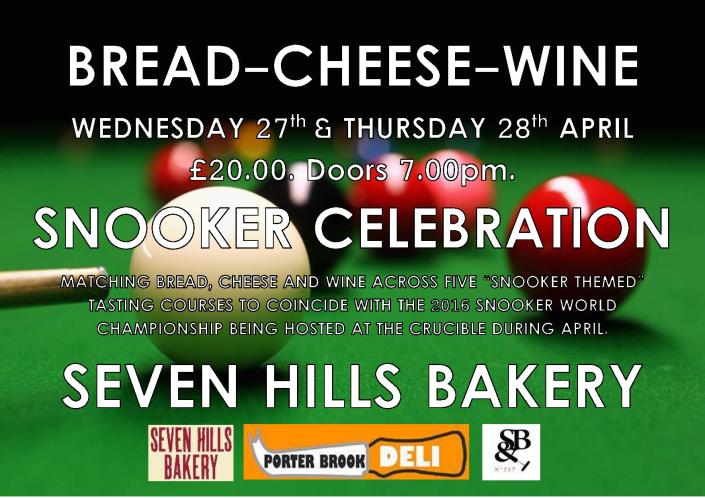
FRAME 1. WHITE & RED Breadstick Cue
This dough is made using a poolish which means that part of the dough is fermented overnight to increase flavour and texture. We then added olive oil for elasticity and flavour. The ‘cues’ are shaped by hand, proved then baked in a fairly hot oven to dry out. Sundried Tomato Ciabatta : This is made using the same method as the ‘cue’ but with a more relaxed dough (added water). We then add soaked Sundried tomatoes.
FRAME 2. GREEN & YELLOW Herb Focaccia
A traditional Italian bread. Ours is made as a lean dough, just flour, water, salt and yeast. Herbs and lashings of olive oil are then added. This bread is not shaped as such, but is rather pressed into a tin. Butternut Squash & Sesame Roll : No yeast is added to this dough. A wide range of yeasts and bacterias exist on flour and in water. We ferment the flour and water together to make a ‘mother’ and this leavens the bread. We make this bread over a three day process which gives it its chewy, holey texture and slightly tangy taste. We added roast butternut squash to the dough, rolled it in sesame then proved it in the fridge overnight before baking.
FRAME 3. BROWN & BLUE 100% Wholemeal
We use Yorkshire Organic stoneground wholemeal flour for this dough. It is both grown and milled in North Yorkshire and is delicious and naturally sweet. We make this bread using a ‘flying poolish’ which is where all the yeast is added to one third of the total flour and water and fermented for an hour or so before being added to the remaining flour, salt and water to make the final dough. This is one of the few loaves me prove in a tin this is because the structure needs the support of the tin to rise.
FRAME 4. PINK Beetroot Sourdough: We make all our sourdoughs using the same method (just flour, water and salt) but with differing flours and sourdough starters. This bread is made from our white sourdough. We grate beetroot fresh and add to the final dough. The beetroot makes the dough very soft and naturally sweet.
FRAME 5. BLACK Black Bread: This is our version of a Russian Black Bread. This is based on our 100% rye sourdough loaf. To which I added Yorkshire Organic Millers 85% white flour (regular white flour is around 72% extraction*) malt extract, black treacle and caraway seed. Whilst researching this bread I found it very hard to get a firm consensus regarding what the flavours of Russian Black Bread should be. Some said coffee, old rye breads, chopped rye and many other ingredients, but I think these flavours work well and will intensify over time. *extraction: Grains are milled to create flour. They are then sieved to separate out the flour, bran, germ and semolina. Wholemeal flour is where all these ingredients are added back together, so you are eating all the grain. Or they are either left separate which makes the whitest flour at around 72% grain and 28% bran, germ and semolina that are not added back
and will be sold separately. The 85% will have a higher proportion of the bran, germ and semolina in the flour.
CHEESE
Sparkenhoe Vintage Red Leicester
The only unpasteurised farmhouse red Leicester made in the world. This version of Sparkenhoe red Leicester is the vintage profile; aged for 18 months, which gives it a strong, powerful flavour. Made by Jo and David Clarke in Market Bosworth, Leicestershire, England.
May Hill Green
Made with a mixture of pasteurised milk of rare-breed Gloucester and Friesian cattle in a manner similar to Stinking Bishop, except that the rind is not washed. Instead the rind is topped by chopped nettles and coiled by a Beechwood lath to give the cheese a distinct character. The paste is semi-soft with a soft and runny texture and a peppery finish. Flavour is lactic with and fairly strong aroma. It is great cheese to serve on a cheeseboard or spread on flavoured bread. Made by Charles Martell in Gloucestershire. Vegetarian.
Gjetost / Norwegian Brown Cheese
Gjestost is made using pasteurised cow’s and goat’s milk. The name is derived from the Norwegian for goat – Gjet. The cheese is made by boiling the leftover whey from the cow’s and goat’s milk together until the lactose caramelises. Norwegians enjoy Gjetost with coffee for breakfast, shaved thinly on flatbread or with spiced fruit cake at Christmas.
Perl Las
A delicious, creamy-textured, blue cheese from Carmarthenshire, Wales. Made by Carwyn Adams. When young, Perl Las (which translates as blue pearl in English) has a delicate blue taste. When mature, it becomes golden in colour and fuller in flavour.
Goat curd White Lake Cheese was started in 2004 by Peter Humphries and Roger Longman. Based in the heart of Cheddar Country they make a range of artisan Goat’s, Sheep’s and Cow’s milk cheeses. The goat curd is a very fresh version of cheese. The Goat’s milk comes from Rogers own herd,
Pecorino Nero
Made by the Fabbri family in Tuscany. The Tuscan ewes enjoy fragrant and aromatic pastures, which produce rich milk. The rind is rubbed with olive skins to create the characteristic black colour, and the cheese is matured for six months to produce a harder texture and a full flavour.
WINE
La Amistad 2014 Alicante alc 13% Low Sulphur
Not quite a red or rose this is a natural wine made by organic farming methods. The grapes are harvested by hand and minimal handling of the Rojal grape is encouraged to get to the winery as quickly as allowed. The skins of the grapes are left in contact with the must (unfermented grape juice) for a few hours only. Aged in Tinajas clay pots to allow the wine to settle before bottling. Produced in small quantities. The wine is lively and fresh in the mouth. We have lightly chilled it to match the Red Leicester to retain a fresh and crisp opening.
EsTe Vinho Verde Loureiro alc10% vol
Green Wine A really fresh easy drinking white from the N.W of Portugal, located 30 km from the Atlantic coast. This wine is made from a single variety Loureiro, which is one of the more aromatic grapes from the Vinho Verde area. A wine that is finding many ways to be enjoyed from simple summer drinking to sea food and light grilled meats. This links well to the May Hill Green semi soft style.
Vin Jaune Daniel Dugois
This may be one of the most unusual flavours from a white wine you have had so far. The theme this month allows us to have some fun and choose some more off the wall combinations. This Vin Jaune is made by the Savagnin variety and is made in a method close to a Fino Sherry wine allowing a Veil of yeast to form in the barrel. The bottle Clavelin is 62cls which is the desired amount of wine left after ageing from an initial litre of wine !
Delgado Zuleta Medium alc17.5% vol
Brown Tinges This is a blend of Amontillados with the age of the youngest wine no less than four years. As Sherry wine goes this has delicate notes of flavour from the Palomino grape and careful oak barrel ageing. It lies somewhere between a youthful Fino and maturing Amontillado. The Bodegas is still owned by two families.
Jeio Rosato
Sparkling from the Prosecco producing area Valdobbiadene. I will leave the blue to the cheese! This super spumante style wine from the family Bisol. Made with mainly Merlot and Pinot Noir grapes and some Glera for the finesse .The colour comes from the skins of the two red grapes. With this in mind we have a super cleansing feeling to work with the Per Las cheese.
De Bortoli Black Noble fortified wine alc17.5% vol
An aged Semillon with toasty barrel flavours from the toasted American and French oak. With concentrated flavours of coffee, toffee, anise and dried fruits developing in the glass we end with this super sweety from Australia.
 BREAD-CHEESE-WINE